Reog Ponorogo encompasses more than just performance. It appears that this picture presents two different interpretations of historical events.
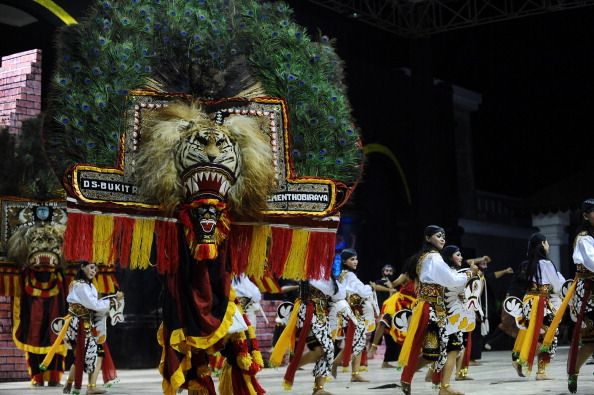
Reog Ponorogo is thought to have existed for hundreds of years, although no documents describing when this art form first appeared have yet been discovered. In light of the continued practice of animism and dynamism, Reog Ponorogo may have existed, according to Reog Ponorogo researcher Rido Kurnianto.
"The year has not yet begun for the community development version. However, there are still occasional Ponorogo people that practice animistic and dynamic ceremonies. That implies that a considerable period has passed. Some even claim that ever since the settlers arrived in Ponorogo, "Rido said to DETIKCOM.
This viewpoint, according to Rido, could not be dissociated from the tiger and peacock figures in the Reog Ponorogo show. In Javanese culture, these two creatures are potent symbols.
"The tiger and peacock were pioneer creatures in the woods during their period. The strongest, wildest, and bravest animal was the tiger. Although the green peacock was the best and most gorgeous bird, "added he.
There are white, blue, and purple peacocks, but they cannot compare to the beauty of the green peacock. Ponorogo's forefathers were particularly adept at selecting peacocks, which were later renowned as native to Java and the best.
The community also performs a ceremony in which it rejects reinforcements using the combination of tiger and peacock. The society believes that when both factors are present, bad things might spiral out of control.
Rido declared, "Ponorogo people with strong personalities and admirable morals, reinforcements won't come.
Rido too has a different viewpoint of Reog Ponorogo's appearance. It's possible that this work dates back to the 14th or 15th century if it's connected to the version of the Reog Ponorogo legend.
This theory is supported by the history of Reog Ponorogo's rise in the Kingdoms of Majapahit and Kediri. According to Rido, Suru Kubeng and Bantarangin are currently thought to be the two versions of the narrative that served as the inspiration for Reog Ponorogo's performances.
Suru Kubeng, also known as Ki Ageng Fleas, is the original version. Ki Ageng Kutu created this reog as satire directed at King Brawijaya V, the reigning monarch of Majapahit at the time who was ruled by his consort Putri Campa.
"The main rationale, according to Suru Kubeng, is satire or critique. Thus, the dance is meant to mock. The Reog Ponorogo art form's pivotal dance, Brawijaya V, has a barongan, or tiger riding a peacock. It's similar to how Dewi Campa rode Brawijaya V due to government regulations or how his wife rules the realm "Rido stated.
The background of the Kingdoms of Bantarangin and Kediri is taken in the second version, Bantarangin. This narrative starts with a quest for love and ends in conflict.
At initially, Putri Sanggalangit, a daughter of the Kingdom of Kediri, was to be the target of a marriage proposal from the King of Bantarangin, Kelana Suwandana.
However, an emissary from the King of Kediri named Singabarong intercepted him on the way there. It appears that Singobarong also wants to contend for Princess Songgolangit. With his army of lions and birds, Singabarong arrived.
Warok accompanied King Kelana and Bujanganom, who served as his deputy. Warok, the king's bodyguard, possesses the ability to use black magic to eliminate his adversaries.
Then the two kingdoms engaged in a duel war. Due to the overwhelming strength of both sides, the battle lasted several days without a clear victor. As his energy diminished, they finally found common ground.
Finally, King Bantarangin's request to marry his daughter was accepted by the King of Kediri. The peacock, lion, and warok army put on shows for spectators as the bride and groom get married.
"Then stage reog, arable reog, or studio reog were born from this Bantarangin. In this instance, it is presented annually during national festivals, "Rido said.
H. Ahmad Tobroni, also known as Mbah Tobron or Reog Ponorogo's elder, noted that despite their differences, they did not have any issues. He finds the contrasts to be intriguing and has been investigating reog since 1948.
Both of them combine to provide a lovely performance, he remarked.

Tidak ada komentar:
Posting Komentar